
Blindsight: Why Your Customers’ Brains Have Already Started Buying Before They Know It
Have you ever walked into a supermarket intending to buy one thing…
…and walked out with a trolley full of things you definitely didn’t plan to buy?
Or perhaps you’ve picked up a bottle of wine because the label looked nicer.
Ordered the “chef’s recommendation.”
Or convinced yourself that Coca-Cola simply tastes better than Pepsi.
Here’s the interesting bit…
Your brain probably made those decisions long before you realised it had.
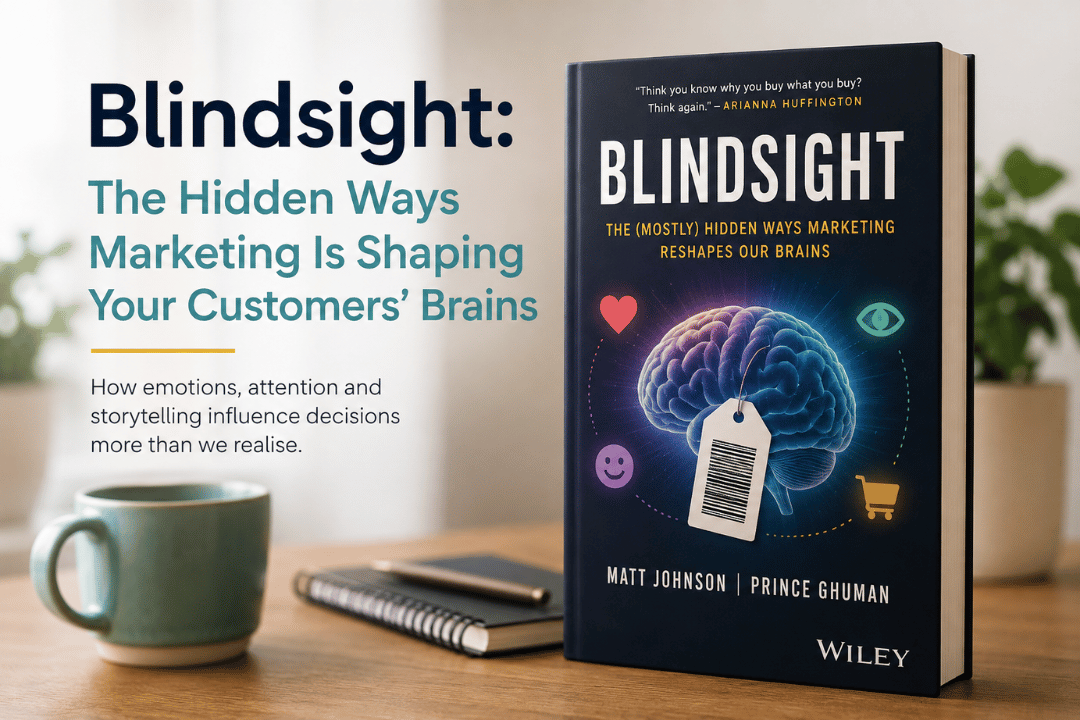
That’s the fascinating premise behind Blindsight: The (Mostly) Hidden Ways Marketing Reshapes Our Brains by Matt Johnson and Prince Ghuman.
It’s one of those books that makes you look at the world completely differently.
You’ll never see supermarket shelves, restaurant menus, logos, or even your own marketing in quite the same way again.
So, if you haven’t got time to read nearly 300 pages of neuroscience, psychology and marketing – because you’re busy running classes, organising camps and trying to work out why there’s always one unnamed water bottle left behind – here’s your done-for-you reading service.
Who Are Matt Johnson and Prince Ghuman?
Matt Johnson is a neuroscientist.
Prince Ghuman is a marketer.
Together, they’ve combined brain science with real-world marketing to answer one big question:
Why do people buy what they buy?
And their answer is surprisingly simple.
We like to think we’re rational.
We’re not.
Our brains are making hundreds of unconscious decisions every day without asking our permission.
The Big Idea of the Book
If I had to summarise the entire book in one sentence, it would be this:
People don’t experience brands consciously as much as they think they do.
Instead…
Our brains are quietly noticing patterns.
Making assumptions.
Building memories.
Creating emotional responses.
Long before we’re aware of any of it.
The authors call this “blindsight.”
Influences we don’t consciously notice…
…but which quietly shape almost every buying decision we make.
The Menu Changes the Meal
One of my favourite examples in the book isn’t actually about marketing at all.
It’s about restaurants.
Imagine ordering the same steak.
One menu describes it as:
“Grilled sirloin.”
Another describes it as:
“Locally sourced, grass-fed sirloin, flame grilled and served with rosemary butter.”
Same steak.
Different experience.
Research consistently shows we enjoy the second one more.
Why?
Because expectation changes experience.
Our brains don’t simply react to reality.
They react to what they expect reality to be.
That’s an incredible lesson for activity providers.
Parents aren’t just booking a holiday camp.
They’re imagining the holiday camp.
Your marketing shapes that imagination before their child even arrives.
Why Coca-Cola Usually Wins
The book explores one of the most famous experiments in marketing.
When people taste Coca-Cola and Pepsi without knowing which is which, the results are often surprisingly close.
Sometimes Pepsi even comes out on top.
But…
Tell people they’re drinking Coca-Cola…
…and suddenly their brains respond differently.
The brand itself changes the experience.
That’s astonishing when you think about it.
It means branding isn’t just something wrapped around a product.
It actually becomes part of the product.
Which raises an interesting question…
When parents see your logo…
Your colours…
Your instructors…
Your website…
What expectations are you creating before they’ve even walked through the door?
We Don’t Buy Facts
This was probably the biggest lesson I took from the book.
We all think we make logical decisions.
“We compared the options.”
“We looked at the reviews.”
“We checked the prices.”
And yes…
We do those things.
But emotion usually gets there first.
Think about your own business.
Parents aren’t buying:
- 45 minutes of gymnastics
- a football session
- a coding club
- a holiday camp
They’re buying confidence.
Belonging.
Friendships.
A child who can’t wait to tell them about their day.
That’s why marketing that focuses only on facts often falls flat.
Facts explain.
Emotion persuades.
Memory Is Your Marketing Department
One whole section of the book explores memory.
Not how memories work…
But how brands deliberately create them.
Think about businesses you instantly recognise.
McDonald’s golden arches.
The Netflix “ta-dum.”
The smell when you walk into a bakery.
A particular shade of blue.
A slogan you’ve known for years.
Those things aren’t accidents.
They’re memory triggers.
And activity providers can do exactly the same thing.
Perhaps it’s your signature warm-up.
The way your coaches celebrate achievements.
A catchphrase your instructors always use.
A particular style of photography.
A themed holiday camp every summer.
Tiny details become memorable experiences.
And memorable experiences become memorable brands.
Stories Beat Statistics Every Time
One of the strongest messages running through the book is that our brains are wired for stories.
Not spreadsheets.
Not statistics.
Stories.
Think about your marketing.
Which is more memorable?
“We help children build confidence.”
Or…
“Last September, Sophie cried all the way into her first class. Six months later she was standing at the front helping welcome new children.”
One is information.
The other creates emotion.
And emotion is what people remember.
Your Brain Loves Familiarity
Have you ever noticed how a song you didn’t particularly like somehow becomes catchy after hearing it a few times?
Brands work in much the same way.
Psychologists call it the mere exposure effect.
The more often we see something, the more comfortable it feels.
Suddenly…
Last year’s “Say It Again!” blog makes even more sense (click here to read it)…
Posting once isn’t enough.
Parents need to become familiar with your business.
Not because you’re annoying them.
Because familiarity builds trust.
And trust builds bookings.
So… What Does This Mean For Activity Providers?
This is where I think the book becomes incredibly practical.
The next time you’re writing a Facebook post…
Don’t ask:
“What information do parents need?”
Ask:
“What do I want them to picture?”
The next time you update your website…
“Does this explain our classes?”
“Does this make a parent imagine their child here?”
The next time you’re taking photographs…
Don’t photograph equipment.
Photograph emotion.
Because that’s what people remember.
So… Is It Worth Reading?
Absolutely.
Especially if you:
- want your marketing to stand out
- struggle to explain what makes your business different
- want parents to remember your brand
- enjoy understanding why people make decisions
- are fascinated by psychology and human behaviour
This isn’t really a marketing book.
It’s a book about people.
Marketing just happens to be the lens the authors use to explore them.
Final Takeaway
People don’t choose the business they know the most about. They often choose the business that feels the most familiar, memorable and emotionally meaningful.
That’s a huge shift in thinking.
Because it means your marketing isn’t just sharing information.
It’s quietly shaping expectations.
Creating feelings.
Long before someone clicks “Book Now.”
And perhaps that’s the biggest lesson of all.
People don’t just remember what your business does.
They remember how it made them feel.