
Book of the Month: Fans! Not Customer
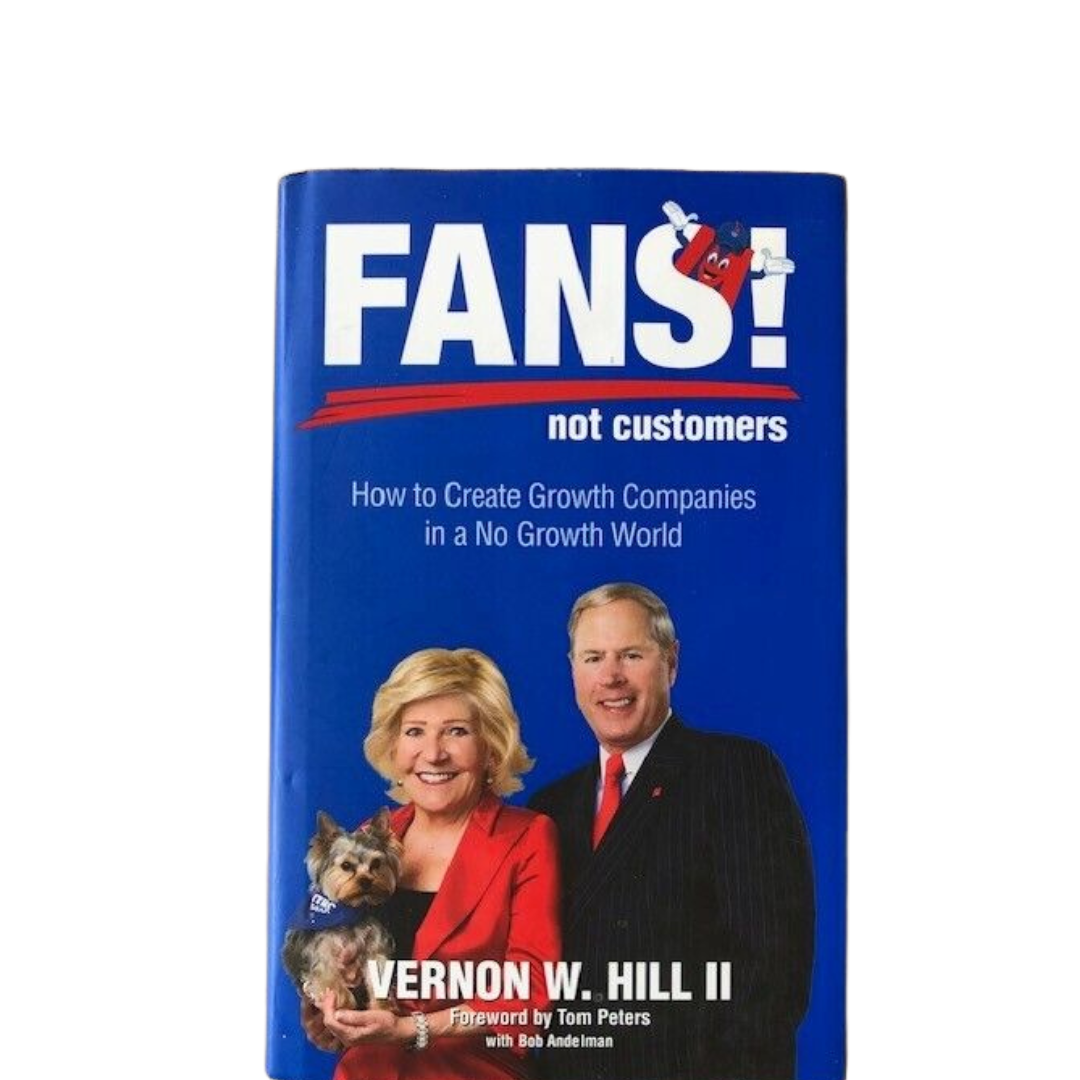
Fans! Not Customers is Vernon Hill’s explanation of his entrepreneurial and innovative approach to an industry full of accepted norms and rules that, in Hill’s opinion, are silly and are made at the expense of the customer – customers who should be fans.
Fans! Not Customers shows how to turn your customers into your greatest allies by providing a plethora of examples from Hill’s experiences with Commerce Bank and Metro Bank UK, and contains insights into the thinking behind the small things that have made Hill’s businesses stand out from their competitors – things like why their pens aren’t chained to the desk, or why customers are encouraged to bring their dogs into the store.
It’s Vernon Hill’s belief that great companies are only built by fans, not customers. It’s this belief that stands behind the customer-centric business model that both Commerce Bank and Metro bank were built around – a model that in this book he breaks down, explains and maps out for you to use in your business.
How to create fans, not customers…
Vernon Hill begins Fans! Not Customers with a promise, the promise that this book can work for a woman starting a one-person accountancy, or for a CEO of a big company trying to stand out in a crowded market. It does not, however, work for the faint-hearted – to be this different takes guts and equal dedication to the vision and the execution.
Hill then explains why his bank, Metro Bank, is different; it has stores rather than branches, team members rather than employees and it doesn’t chain its pens to the desk.
Couple this with the fact that Hill’s banks are open seven days a week, opening early and closing late, and you start to build up a clear picture of how Hill disrupted the norms set by the banking industry with his retail-focused, customer-centric business model.
Before moving up to the rest of the story, of how Commerce Bank and Metro Bank began and the explanation of the model that sits firmly behind them, Hill addresses his fellow entrepreneurs, urging you to recognise and grasp your opportunities as they present themselves and learn how you can deliver value, differentiation and improvement.
Hill suggests that every conversation about building a great brand, generating wealth and creating fans starts with three primary elements:
Differentiated model
Pervasive culture
Fanatical execution
= fans, not customers
Making companies soar is about the development of environment, the attention to detail and the great respect for creative aspects. Hill argues that great design is a pillar of great companies.
Hill suggests that a unique business model is key if you are looking to turn your customers into fans. You must believe in your model, and making money should be the result of what you do, rather than the objective.
As you create your own unique model, you, your management and the model, need to continually grow and improve. Your choice is either to improve and grow, or calcify and die.
Marketing Is Everything
Fans are customers who embrace your model and culture, they become part of your community and convert their friends to new customers of your brand. Emotional brands create massive value and you need fans in order to create an emotional brand. How do you create fans? One way you can do this is through marketing.
Every new Metro Bank store celebrates its opening in grand style for two full days, Friday and Saturday. They have a carnival like atmosphere, with cards being handed out that offer the recipient £20 to switch accounts and all customers are told to invite their family and friends.
In the run up to the store opening, a VIP party is held on the Wednesday before the Grand Opening on Friday, with Thursday being used to stock and decorate the store. All team members attend a training day, specifically designed to get them clued up on all of the possible situations that they might come across whilst working a store opening.
Why does Vernon Hill make his store openings into such a production? First impressions are lasting, and Hill implores you to celebrate your new customers. Also, celebrate that you are becoming part of a new community. If you make it into an event, if you believe that it’s an event then your customers will too.
The New Math
Every decision you make either adds to or subtracts from your brand, Hill suggests, and he has developed a number of formulas to explain the way things are done in his businesses, the most predominant being:
Model + Culture + Execution = Fans
According to Hill, Metro Bank’s culture is the social fabric of the business – it matches the model and is pervasive throughout the organisation. The thing about culture, Hill says, is that you can’t merge it, you can’t acquire it and you can’t convert it. You have to create it and your culture is the spirit that will enable your company to excel.
However, a company can have a great model with a reinforcing culture, but execution determines its fate. Here are what Hill offers as the keys to fanatical execution:
Believe in your model
Over-invest in facilities and people
Demand 100% execution
Surprise and delight!
When responding to customer requests, Hill’s team in both Commerce Bank and Metro Bank are given the same brief – ‘it takes one person to say yes, and two to say no’.
They’re given two choices:
Say ‘yes’ and solve the issue immediately or…
Find someone else who can.
To say ‘yes’ requires a combination of both attitude and substance, substance that comes in four parts:
Product knowledge
Company knowledge
Listening skills (listen, understand, then respond to the customer)
Problem solving skills (know how to fix things and fix them fast)
There is also a list of three forbidden phrases within Metro Bank:
“We can’t do that” becomes “Let me get some help/is there something else I can do for you?”
“I don’t know…” becomes “I’ll find out for you…”
“Sorry, you’ll have to…” becomes “Here’s how we can help you with that…”
Culture Counts
Throughout Fans! Not Customers, Hill stresses how important the culture that you create within your business is: he has created a culture to match his business model, and that’s why it works so well.
Hill argues that a culture that is driven only by making money, with a focus on driving costs down and productivity up will not succeed. He believes that companies that grow believe in their growth model, so much so that they over-invest in it and it’s this that creates value.
Five Ways to Amaze
If you want to create a great business model, then you need to create a pervasive culture that executes a differentiated model – and fanatically executes it in order to exceed your customer’s expectations! Hill says that the number one customer principle that will take Metro Bank to be where he wants it to be can be summarised in one word – AMAZE!
Here’s how they spell it out, with a few examples from Hill’s own business:
A – Attend to every detail
Attend to every detail of the customer experience and make sure that whatever issue you’re dealing with is accurate.
“A Metro Bank team member had a customer who only spoke Arabic. Unable to find another team member who could translate, he called several friends until he found one who could translate for him. He put the customer on the phone and was able to complete the desired transaction.”
M – Make every wrong, right
To err is human, and to recover is divine. At Metro Bank they apologise to every customer and give them a satisfaction guarantee, as well as putting their money where their mouth is and giving their customers money.
“When we had a processing problem with MasterCard, it came to our attention that a customer couldn’t pay for their airline flights. A Metro Bank team member stepped in. She put the customer’s flights on her personal credit card so that the customer could still take advantage of the good deal and transferred the money, with their permission, from their account.”
A – Ask if you’re not sure, bump it up
Metro Bank empower their employees, so that if they feel that it’s the right thing to do then they have the authority within certain guidelines to make decisions based on customer welfare, and all are encouraged to never say ‘no’ at the first opportunity.
“At a training course a team member asked why self-authorisation for a customer was capped at £5,000, when an ISA allowance is £5,000. This rule caused extra permission to be sought every time. By bumping this up to our chief executive, who immediately changed the threshold, customers and colleagues have been saved a great deal of time and frustration.”
Z – Zest is contagious, share it
Zest is all about behaviours. When staff come into Metro Bank for the day, Hill wants them to have a zest for their job that shows.
“A customer service representative collapsed during training and the paramedics were called. Whilst in the ambulance, she told them about how good Metro Bank was and sent a fellow team member back to the store to make up goody bags for the paramedics who had helped her. At a later date they all came back and opened accounts.”
E – Exceed expectations
Exceed the customer’s expectations – make their day, make them smile and go the extra mile.
“Team members helped a customer whose handbag was stolen the day before she was due to leave on holiday. Staff kept the store open until the customer was able to get there at 8:45pm. They printed her a new card and ordered in food to share with the happy customer. They then walked her to her car and even paid her parking fee.”
Final Thoughts:
Hill closes his book by asserting that hope is not a plan. He’s tired of business owners prefixing their goals with ‘I hope’. “Let’s not hope about it. Go out and make it happen,” Hill says, claiming that when people use the word hope, they are admitting that they don’t have a plan.
Fans! Not Customers is the story of how Hill made things happen and achieved the goals that he had in mind when he first ventured into business forty years ago.
Hill built a business model that differentiated his business from his competitors’ and built two hugely successful businesses around a customer-centric concept that seemed in many ways alien to the banking industry.
He ignored the norm and made exciting things happen. Remember, in the words of Vernon Hill – entrepreneurs make things happen, they don’t wait for miracles.
About the Author:
Often credited with reinventing American banking, Vernon Hill is the founder and former Chairman and president of Commerce Bank, which he founded in 1973 as a one-branch bank in metro Philadelphia with nine staff and $1.5 million.
By applying his philosophy that great companies are built by fans, not customers, Vernon built Commerce Bank into one of the largest banks in America with 15,000 team members, 500 branches and $50 billion of assets. It was purchased in July 2007 by TD Financial for $8.5 billion. Commerce was voted the best bank in America in 2006, 2007 and 2008 by JD Power and Associates for its absolute commitment to customers.
Hill brought his success to the UK by launching Metro Bank in London in July 2010.