
Why Geomarketing is a Game Changer for Expanding Your Franchise Network
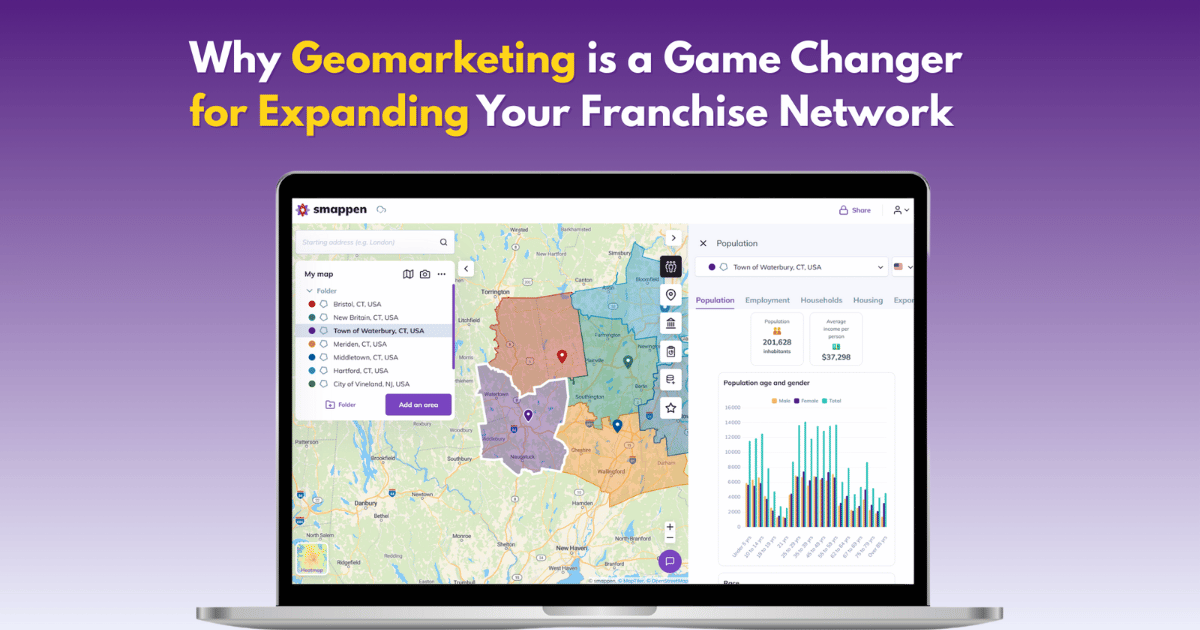
Expanding a franchise — especially in the children’s activity sector — is no small feat. Between identifying ideal locations, assessing competitor presence, and understanding customer behaviour, the process can quickly become overwhelming.
This is where geomarketing steps in as a powerful strategy, turning data into actionable insights that guide smarter expansion decisions. Tools like Smappen can provide the clarity you need to grow your business effectively.
So, how exactly can geomarketing give your franchise a competitive edge? Let’s break it down.
Here’s a quick summary of what you’ll learn in this article:
Geomarketing empowers franchises or other networks by providing data-driven insights to identify prime locations, understand customer patterns, and manage territories effectively.
Franchisors in the children’s activity sector can use geomarketing to spot underserved areas, assess competition, and improve marketing strategies.
Using geomarketing tools (like interactive mapping software) simplifies expansion planning and helps businesses grow confidently.
What is Geomarketing?
In simple terms, geomarketing is the practice of using geographic data to inform business decisions. By mapping customer demographics, competitor locations, and travel patterns, businesses can gain insights that help them choose optimal locations, define franchise territories, and target marketing campaigns more effectively.
For franchisors in the children’s activity sector, this data is invaluable. Understanding where families live, how far they’re willing to travel, and which areas are underserved can make all the difference when expanding your network.
Why Geomarketing is Essential for Franchise Expansion
Franchise growth requires more than just finding a vacant shop or venue — it’s about identifying locations with genuine potential. Here’s how geomarketing helps make that happen (in the blink of an eye)
1. Identifying prime locations for growth
The success of a children’s franchise heavily depends on its location. Families prioritise convenience, so opening a new branch in the wrong area — even with a great concept — can spell disaster.
Geomarketing helps identify neighbourhoods that align with your target audience. By analysing population density, family demographics, and local amenities (like schools, parks, or community centres), you can confidently pinpoint ideal expansion zones. A good indicator may also be to identify office or residential centres. You can also go a step further by identifying the distribution of the population by age or household composition.
For example, if you run a tutoring franchise, geomarketing might reveal that a particular area has a high number of families but limited education services — a prime opportunity to establish your presence.
2. Understanding customer catchment areas
Customer behaviour is rarely uniform — especially when it comes to family activities. While some parents may drive 30 minutes for a top-rated gymnastics class, others prefer options within walking distance.
Geomarketing tools allow you to map realistic catchment zones based on travel times or distances. This ensures:
Each new branch attracts enough families to sustain itself.
You avoid opening too close to an existing franchise location.
Your network grows without cannibalising your own customer base.
By mapping these zones, you can confidently define boundaries that balance growth with customer convenience.
3. Analysing competitor presence
Competition is unavoidable in the children’s activity sector. However, geomarketing can help you strategically position new franchises by identifying areas where competitors are over-concentrated — or better yet, where they’re missing altogether.
By mapping competitor locations, you can spot underserved areas that align with your target market. Also you can assess whether a competitor’s presence is too strong in certain zones. And then, identify unique selling points that set your franchise apart in busy markets!
This data helps you expand confidently without risking oversaturation or unnecessary competition.
4. Targeting the right marketing campaigns
Marketing isn’t just about reaching parents — it’s about reaching the right parents.
Geomarketing enables you to identify neighbourhoods with strong demand for your services. For example, if you run a kids’ drama club, you can target areas with a high concentration of primary schools or community centres.
By tailoring your marketing strategy to focus on these key areas, you can:
- Maximise your marketing budget.
- Deliver promotions to families who are most likely to engage.
- Plan local events in high-potential neighbourhoods.
This targeted approach ensures your efforts are both cost-effective and impactful.
5. Managing franchise territories
Expanding a franchise network requires careful territory planning to avoid internal competition.
Geomarketing tools allow you to create custom territories based on population density, travel distances, or postal boundaries. This helps:
Ensure each franchise serves a unique customer base.
Prevent overlapping territories that risk dividing your audience.
Maintain fair opportunities for franchisees to succeed.
By establishing clear boundaries, franchisors can maintain harmony across their network while supporting sustainable growth.
How Geomarketing Tools Simplify the Process
Traditionally, gathering this level of data required complex analysis or expensive market research. Fortunately, modern geomarketing tools have made the process far simpler and more accessible.
These platforms provide:
- Interactive Maps — Visualising key data like demographics, travel patterns, and competitor locations.
- Custom Territory Drawing — Allowing you to define boundaries for franchise zones.
- Demographic Insights — Helping you identify areas rich in your target audience.
- Travel Time Analysis — Showing how far customers are willing to travel to reach you.
For franchisors in the children’s activity sector, these insights eliminate guesswork and provide a solid foundation for growth decisions.
Example: expanding a children’s dance franchise
Imagine you own a chain of children’s dance studios and plan to expand. Here’s how geomarketing could guide your decisions:
Mapping Potential Areas: By analysing demographic data, you spot family-friendly suburbs with a high number of schools and parks.
Assessing Competitors: For example, you could identify areas that competitors have overlooked.
Defining Territories: Geomarketing tools reveal that families are willing to travel up to 20 minutes for dance classes,giving you clear boundaries for your new branches.
Targeting Marketing Efforts: With data insights, you focus your promotional efforts on the highest-potential neighbourhoods. And ideal areas to target social media ads and local promotions.
By blending data with strategic thinking, geomarketing helps ensure each new franchise location has a strong chance of success.
Why Geomarketing is Crucial for the Children’s Activity Sector
The children’s activity sector presents unique challenges — from understanding school schedules to accommodating parent routines. Geomarketing helps franchisors address these challenges by revealing:
Where family-dense areas are located.
Which travel distances are realistic for your target audience.
How to avoid competing too closely with existing franchises.
For businesses like tutoring services, dance studios, and kids’ gyms, this data-driven approach is essential for building a thriving network.
Conclusion: Geomarketing — Your key to smarter expansion
In a competitive industry like the children’s activity sector, guessing where to open your next franchise can be risky. Geomarketing removes the guesswork by offering clear insights into customer behaviour, competitor presence, and marketing opportunities.
By using data to guide your decisions, you can expand confidently, avoid costly mistakes, and build a network that thrives in the long term.
Tools like Smappen, which are easy to use and provide highly reliable data, can help you take the plunge!
FAQs
1. Do I need advanced technical skills to use geomarketing tools?
Not at all! Many modern geomarketing platforms are designed to be intuitive, making it easy for franchisors to analyse data without technical expertise.
Smappen’s intuitive interface makes it perfect for business owners who don’t have a background in data analysis. The software is designed to be intuitive and user-friendly, and count over 1,000 customers, 40% of whom are franchises.
2. How can I tell if an area has strong family demographics?
Geomarketing tools often provide population data, age distribution, and income insights — all key indicators of family-rich neighbourhoods.
3. Can geomarketing help if I already have an established network?
Yes! Even for established franchises, geomarketing can reveal gaps in your coverage, identify potential relocation opportunities, or guide smarter marketing decisions.
4. Is geomarketing only useful for franchise businesses?
Not at all! Retail stores, service providers, and even event organisers can benefit from geomarketing insights.
5. How often should I review geomarketing data?
It’s wise to revisit your data regularly — especially before major expansion plans, marketing campaigns, or territory adjustments.
By embracing geomarketing, you’ll turn expansion planning from a guessing game into a strategic, data-driven process — and set your franchise up for lasting success.
ICAP members get an exclusive offer with Smappen. Click here for more details.