
Staying Strong Through Economic Uncertainty
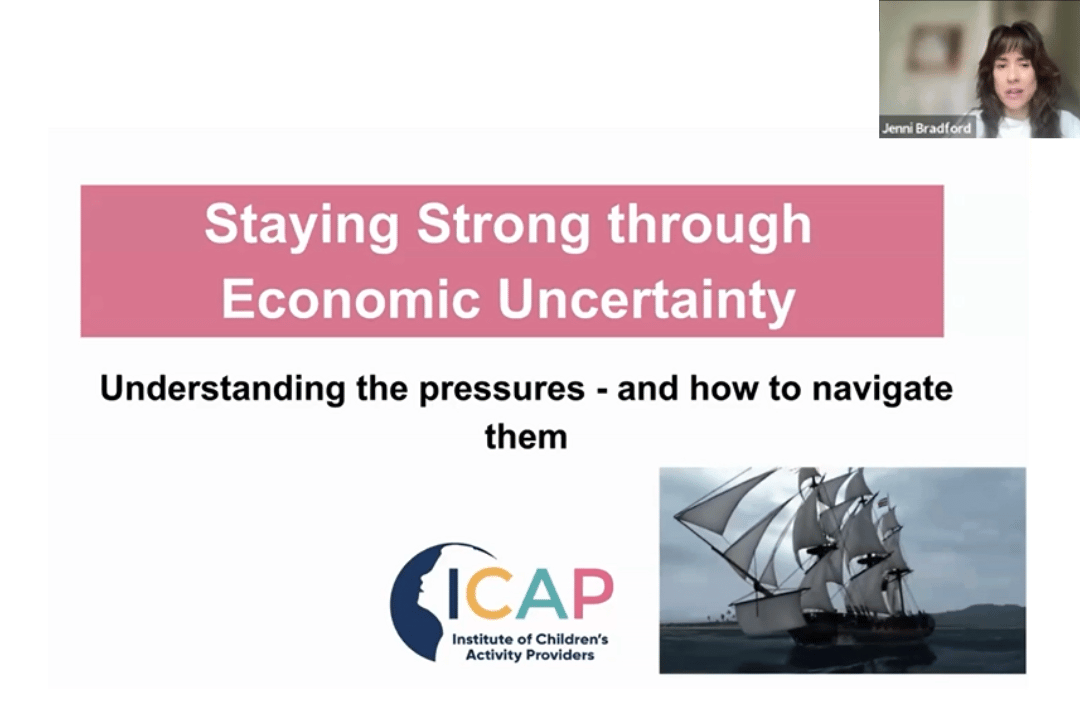
Economic uncertainty can feel relentless for children’s activity providers, clubs, holiday camps and education-based businesses. Rising costs, cautious consumer spending and shrinking margins are creating pressure across the sector.
Yet challenging periods also create opportunities for businesses that remain focused, agile and customer-led.
The key is understanding where the real pressures lie and taking practical action before small issues become major problems.
This blog, based on the latest ICAP webinar presented by Dr Jenni Bradford, explores the current economic landscape and provides a clear 90-day action plan to help your business stay resilient, protect profitability and continue growing.
Why Many Activity Businesses Are Feeling the PressureAcross the UK, many family-focused businesses are being squeezed from both sides.
On one hand, operating costs continue to rise. On the other, customers are becoming more careful with spending.
This creates a difficult balancing act: maintaining quality while protecting profitability.
The Main Pressures Include:
- Rising wage expectations and staffing costs
- Increased venue hire and facility expenses
- Fuel and transport costs affecting both staff and families
- Energy costs pushing up prices across the board
- Families reviewing discretionary spending more carefully
- Increased price comparisons before booking
While demand for children’s activities still exists, parents are becoming more selective about where they spend.
That means businesses need to communicate value more clearly than ever before.
You’re Better Positioned Than You Think…
Here’s the bit that often gets forgotten…
The children’s activity sector is actually in a much stronger position than most.
You’re not a faceless business hoping someone clicks “add to basket” at 10pm.
You see your customers every week. You know their names. You watch their children grow in confidence, skill, and independence right in front of you.
That kind of connection? It’s gold.
You’ve built real relationships with families — the kind rooted in trust, familiarity, and consistency. You’re part of their routine. Part of their village.
And what you offer isn’t a “nice to have” in the same way as a takeaway or a new pair of shoes.
You’re helping children build confidence. Develop skills. Feel happier, healthier, and more themselves.
That’s not just valuable. That’s meaningful.
And when something feels meaningful, people fight harder to keep it.
The Three Core Risks You’re Facing Right Now
1. Customer Behaviour Risk
Customer behaviour often changes quickly during uncertain economic times.
Families may still value your service, but they may:
- Delay bookings
- Pause attendance temporarily
- Cancel sooner than before
- Compare multiple providers before deciding
- Become more price-sensitive
What This Means for You
Revenue becomes less predictable.
If bookings are delayed or customers become inconsistent, cash flow can tighten quickly.
2. Cost Pressure Risk
Many providers are experiencing rising costs in several areas at once.
This includes:
- Staff wages
- Venue costs
- Utilities
- Equipment
- Marketing spend
- Travel expenses
Margins become squeezed quietly over time.
Even businesses with healthy bookings can see profits decline if costs are not regularly reviewed.
3. Profitability Risk – The Biggest Threat
This is often the hidden danger.
What’s Happening:
- Multiple costs of increasing
- Resistance to price rises
- More discounting in the market
Profits can quietly erode if you don’t take action.
Your 90-Day Game Plan to Stay Strong
1. Protect and Grow Occupancy
Your first goal should be filling the capacity you already have.
Before adding new classes, locations or sessions, maximise the ones already running.
Aim for 80%+ occupancy wherever possible.
Focus On:
- Filling empty spaces before adding more
- Re-engaging past customers
- Improving enquiries into bookings
A fuller timetable is more profitable than a larger one.
2. Retain Existing Customers
Retention is often the fastest route to growth.
Winning a new customer costs MUCH more than keeping an existing one.
Improve Retention By:
- Checking in with customer when attendance drops
- Celebrating milestones and progress
- Making communication personal
- Rewarding loyalty
- Keeping the customer journey simple
Families stay when they feel progress, trust and connection.
3. Reinforce Value
When budgets tighten, customers ask one question:
“Is this worth it?”
Your job is to answer that clearly and consistently.
Do not just sell sessions. Sell outcomes.
Highlight Benefits Such As:
- Confidence building
- Social development
- Physical wellbeing
- Skill progression
- Routine and structure
- Long-term personal growth
When customers understand value, price resistance reduces.
4. Execute Locally and Efficiently
Efficiency matters.
Review where time, travel and effort are being wasted.
Look At:
- Reduce unnecessary travel (for staff and customers)
- Focus on local, convenient access
- Optimise class scheduling and times
- Prioritise high-performing sessions
Often the quickest profit gains come from simplifying operations. In this environment, convenience becomes a competitive advantage.
What You Should Track Every Week
Waiting until month-end can be dangerous in uncertain times.
Use a simple weekly dashboard.
Key Numbers to Watch:
- Occupancy percentage
- New bookings
- Customer churn/cancellations
- Enquiry to booking conversion
- Cash in bank
- Expected money in over next 4 weeks
- Expected money out over next 4 weeks
Ask yourself weekly:
Do we have enough cash to comfortably cover the next 30 days?
If not, act immediately.
Early Warning Signs Not to Ignore
Take fast action if you notice:
- More cancellations than usual
- Increased failed payments
- Lower enquiry levels
- Staff dissatisfaction
- Sessions dropping below viable numbers
None of these on their own are a crisis… but together – they tell you what’s coming next. Early action is what protects your business – not late reaction.
Cash is King
All of the pressures we’ve talked about – rising costs, cautious customers, margin squeeze – they all show up in one place… your cash.
In tighter periods, cash isn’t about cutting everything – it’s about protecting what keeps revenue flowing. Protect delivery first – everything else is optional.
Priority Costs:
- Staff & instructors
- Venues / facilities
- Core operations
Secondary Costs:
- Underperforming Marketing
- Subscriptions
- Nice-to-haves
You don’t need to make huge cuts – small, fast decisions here create breathing space. Cash saved today gives you options tomorrow.
Speed
In this environment, speed matters more than ever. Encourage monthly payments from your customers, to aid your cash flow. Act quickly on any delayed and failed payments. Delayed cash is just as dangerous as lost cash.
Final Thoughts: Strength Comes from Focus
Economic uncertainty does not automatically mean decline.
Many businesses grow during difficult periods because they stay disciplined while others drift.
Focus on these priorities:
- Retention first
- Occupancy above 80%
- Protect margin
- Communicate value clearly
- Watch cash weekly
- Act early, not late
Above all, stay close to your customers.
If you take control of these things… you put yourself in a very different position to most businesses right now.
The businesses that listen, adapt and lead with confidence are often the ones that emerge stronger than before.
This blog was created from a very special ICAP Emergency Webinar, to help Children’s Activity Providers navigate through uncertain economic times. Click here to watch the full recording of the webinar.
Need more support? Email us at hello@i-cap.co.uk