
When Children Play in the Water Tray
Research indicates that a significant portion—90%—of brain development unfolds between birth and age five1. It’s also widely recognised that skills that children develop in their early years – emotional and physical health, social skills, cognitive function and language development – are absolutely vital to success in later life.
Over the past few decades a wealth of studies and evidence has emerged designed to understand what is happening in children’s first few years of life, and how their brain architecture2 is developing. Brain architecture refers to the circuits and connections that are being built over time, and during these years there are billions of them.
It has become evident that strong and well-used circuits and connections provide faster pathways for information to be transmitted across the brain, meaning a strong foundation is essential for more complex circuits to be built on3. In real terms, providing children opportunities to explore the world around them and build up their brain architecture in their first five years will allow for faster learning and more complex thought as they grow up.
Experiences create connections in the brain. Whether this be messy play with shaving foam, listening to a story or shaking a maraca to some music, experiences are the catalyst for connections and circuits to be made and brain architecture to be strengthened.
Child activity providers are a pivotal and often under-recognised part of the “village” that contributes to children’s development in their first five years. By providing experiences that may not be readily available at home, these activities actively strengthen brain development.
While this series will delve into the specific skills honed through various typical activities, it’s important to remember that every experience a child has access to will build the foundation for the skills they will need to succeed as they grow.
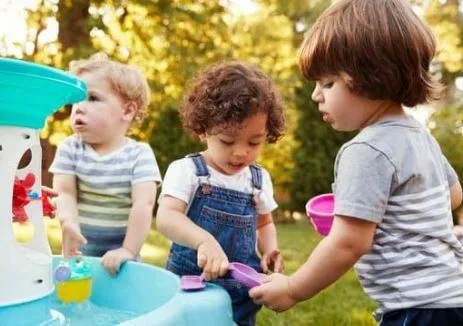
Messy play is meaningful play! Providing water-based play allows children to experiment with pouring and measuring, learn about the properties of water and develop hand-eye coordination.
Yet, beyond these immediate benefits, sensory activities like these enrich children’s early developmental journey.
Outdated notions that young children thrive when left to their own devices have been supplanted by contemporary understanding. Studies show that even the youngest babies should be stimulated at their level from birth. Guidelines from WHO and UNICEF actually recommend that due to their powerful effect on brain architecture and nervous systems, “multisensory interactions should be at the core of early care for babies”4.
Sensory activities are designed to stimulate multiple senses. They present opportunities for infants to absorb a great deal of sensory information (for example, the water feeling cold, the sound it makes as it splashes). This information is then retained and organised through a process called sensory integration. Every child is born with this ability, but it must develop through varied interactions (experiences) with their environment. Just as developing strong foundations in brain architecture will allow for more successful learning later in life, sensory integration allows children to better organise information and develop more complex skills.
Maria Montessori, a luminary in early childhood education, characterised the first phase of child development as a period of sensory absorption, where children build sensory memories that form the bedrock of their understanding of the world. She emphasised the importance of manipulative materials that sustain children’s interest while also appealing to their aesthetic sensibilities. By nurturing children’s senses, providers are able to develop an environment that allows children to notice similarities and differences, and build an appreciation of nuances.
Sensory activities are an essential part of young children’s early experiences, and not just for concrete learning (for example, when water reaches the top of a cup it is called “full”). They allow children to gather and process information about their environment, make sense of the world around them and learn by exploring, building up connections and circuits in their brain as foundations for later challenges and discoveries.
Top Tips
Encourage exploration
The more opportunities there are for children to manipulate materials and explore using their senses, the more powerful (and long-lasting!) a sensory experience will be.
Embrace the mess
Don’t be afraid of mess! Messy play is an important part of sensory exploration and allows children to explore controlled risks and stimulate multiple senses.
1 Lebel C, Walker L, Leemans A, Phillips L, Beaulieu C. Microstructural maturation of the human brain from childhood to adulthood. NeuroImage. Published online April 2008:1044-1055.2 Center on the Developing Child (2007). The Science of Early Childhood Development. 3Ibid
4 Linzarini A, Cebotari V, Richardson D, Vrolijk M, Cunsolo S. How enriching sensory awareness develops and affects well-being throughout childhood. Office of Research. 2021